When Sardis Learned Greek: Stratonike and the Temple That Would Not End
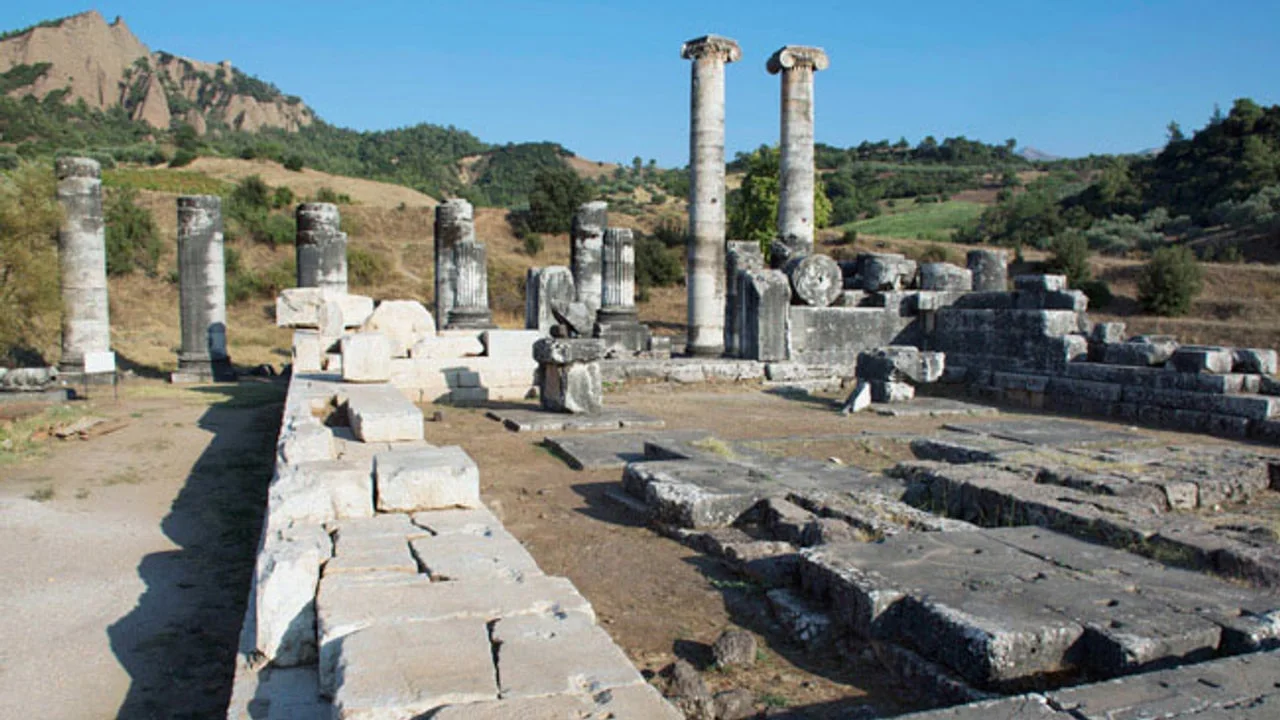
After Sardis surrendered to Alexander in 334 BC, the old Lydian-Persian capital became a Greek polis and Seleucid imperial center without losing its older sacred memory. This article follows Queen Stratonike, the Artemis sanctuary, and the unfinished temple whose Hellenistic cella and Roman double-cult redesign reveal Sardis as architecture's version of the Sacred Blend.
At Sardis, the old Persian gate did not fall so much as open.
In 334 BC, after Alexander’s victory at the Granicus, the city that had once weighed Croesus’s gold and later served the Achaemenid west surrendered to the Macedonian king. The Persian satrap Mithrenes passed into Alexander’s circle; Sardis passed into another language of power. 1 The Metropolitan Museum’s overview states the same turning point more plainly: Persian rule at Sardis ended in 334 BC, when the city surrendered to Alexander the Great. 2
Imagine, then, not a sack but a hesitation: a clerk in the former satrapal quarter rinsing Persian ink from his reed pen; a Lydian grandmother still calling the city by older names; a young Greek officer asking where the royal road ended and where the river of gold began. Nothing essential about the valley had moved. Mount Tmolus still rose behind the city. The Pactolus still ran down toward the Hermus, carrying the memory of gold dust and refinery smoke. 2 But the next chapter of Sardis would not be written only in Lydian, Persian, or the speech of local gods. It would be carved in Greek marble.
The city changed its grammar, not its bones
For two centuries after Alexander, Sardis became something stranger than a conquered capital: it became a Hellenistic city without ceasing to be Sardis. Paul Kosmin’s Harvard Art Museums account frames the period between Alexander’s conquest in 334 BC and Roman annexation in 133 BC as the age when Sardis transformed into a true Hellenistic city, gaining a vast stone temple of Artemis, a theater, a gymnasium, and the institutions and status of a Greek polis. 3
The city’s new Greek face did not erase its older strategic weight. In 282 BC, Sardis became a Seleucid capital and acquired Greek city-state status. 2 Harvard’s Hellenistic Sardis Project describes the same double identity: Sardis was at once a Greek polis and the western imperial center of the Seleucid Empire, home to bureaucrats, royal archives, and even Indian elephants. 3
That is the key to this chapter of the Sacred Blend. Sardis did not become Greek by forgetting Lydia. It became Greek because every new empire needed the old city’s body: the corridor through western Anatolia, the terminus of the Royal Road, the shrine-ground, the administrative habit, the smell of worked metal near the Pactolus. Greek forms arrived not on empty land, but inside an already sacred and bureaucratic place.
Artemis was already waiting outside the city
The great Hellenistic temple did not invent Artemis at Sardis. It magnified her.
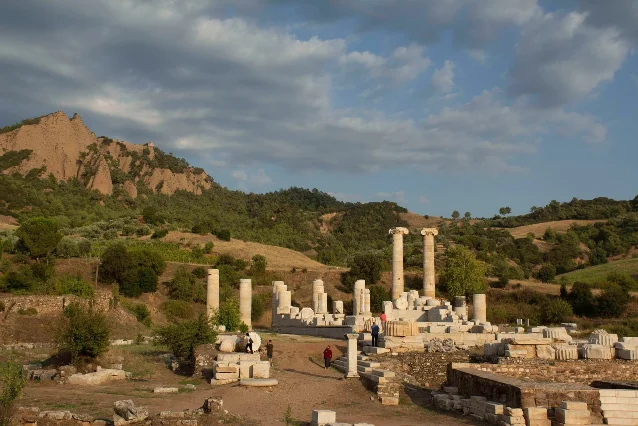
Crawford H. Greenewalt’s study of Lydian religion notes that Artemis had an extramural sanctuary at Sardis, traditionally connected with Ephesus, and that its sixth-century BC existence is supported by sculptural dedications and architectural features. A monumental altar for the Sardian Artemis sanctuary was begun around 500 BC; the huge temple was begun only in the third century BC. 5
This matters because the goddess at Sardis stood at a crossing of religious languages. The same study describes Lydian religion as partly Anatolian and partly Greek, and it places the cult of Cybele or Kuvava near the gold and silver refining installations at Sardis, marked by lion imagery and a painted name fragment. 5 The old city had already learned to let divine names overlap: Kuvava with lions near the refinery, Artemis outside the walls, Croesus’s memory attached to sanctuaries and offerings, Persian administration layered over Lydian habit.
So when the Seleucids raised a colossal Ionic temple in the old sanctuary, they were not importing religion into Sardis. They were translating an older sacred place into the monumental language of the post-Alexander world.
Stratonike’s stone ball
The decisive political moment came after 281 BC. In that year, Seleucus I defeated Lysimachus near Sardis at the Battle of Koroupedion and gained control of most of Asia Minor; Fikret Yegül’s building history says there is general agreement that the colossal temple was started under the Seleucids soon afterward, while also warning that no hard proof ties the start to one exact ruler or month. 6
Seleucus himself was killed only seven months after the victory. If the Artemis temple was truly a Seleucid project, Yegül argues, the real work could hardly have begun before the reign of Antiochus I and his wife, Queen Stratonike, at the end of 281 BC or soon after. 6
Stratonike is one of those figures history leaves half-lit. She was the daughter of Demetrios, son of Antigonus; first married to Seleucus, then to his son Antiochus; a queen who moved through dynastic politics but also through sanctuaries. Babylonian evidence cited by Yegül places Antiochus’s court, wife, and crown prince at Sardis in 276-274 BC, and another Babylonian record says Stratonike died at Sardis between September 24 and October 24 of 254 BC. 6
Then there is the small object that makes her visible: a marble ball about 36 cm in diameter, found in the Temple of Artemis and inscribed, "[Gift] of Stratonike, daughter of Demetrios the son of Antigonus." Yegül treats it cautiously. The surviving lettering appears to be a mid-second-century BC Hellenistic copy of an original dedication, and some doubts remain because the inscription omits her royal title and husband’s name. Yet he also notes that Stratonike often dedicated gifts under her father’s name and argues that, despite caution, this may be the earliest physical document associated with the temple. 6
In the fiction of Sardia, one can see her holding that stone. Not as an architect’s model, not as a command seal, but as a queen’s condensed gesture: a round white thing offered to a goddess who had outlived kings.
The temple worked before it was complete
The surviving building is easy to misread. Two huge columns still stand; the imagination supplies the rest. But the archaeological story is more intimate and more complicated: the temple functioned before it became the temple tourists think they see.
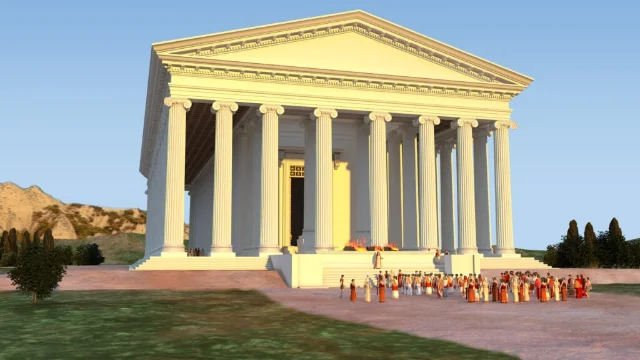
Yegül’s summary of the building’s early phase says the Hellenistic temple began with the cella and interior supports. The exterior colonnade was not completed in that first phase; if it was planned as a dipteral or pseudodipteral monument, the work did not reach the full surrounding forest of columns. 6 The separate Sardis Expedition essay from The Lydians and their World gives the broad sequence: the Hellenistic phase, roughly 300-175 BC, completed the cella and put the temple into use by the end of the third century BC, without an exterior colonnade. 8
How do we know it was in use? Not from a single smoking altar, but from documents in stone.
One Greek inscription, carved inside the northeast corner of the west pronaos wall, records the mortgage obligations of a man named Mnesimachos after he borrowed from temple funds. His estate, including land, villages, dwellings, slaves, and other revenue-bearing assets, served as collateral. Yegül notes that many scholars treat the carved wall text as a later copy of an earlier document broadly datable to 250-200 BC; together with the Stratonike dedication, it favors a building largely complete and in use by the second half of the third century BC. 6
Another clue comes from Didyma. A 254/253 BC inscription records a land sale by Antiochus II to his divorced queen Laodice; the original was placed in the royal archives at Sardis, while copies were displayed in major sanctuaries including Didyma. Yegül follows Gruben in observing that the Artemis sanctuary at Sardis would hardly have been chosen for such honor if it lacked a functioning temple at the time. 6
This is the most Sardian detail of all. The goddess’s house was not only a place for incense. It was also a bank, an archive, a wall of legal memory. The same city that had once refined electrum into coin now allowed sacred finance to speak through marble.
The old coin under the new goddess
At the center of the original cella lay a purple sandstone foundation for the cult image base. In its joints, excavators found 126 Hellenistic coins and one silver croeseid. Yegül is careful about interpretation: the base was disturbed by early excavation, the reconstruction is uncertain, and scholars disagree over whether the croeseid indicates an older pre-temple element or whether the base belongs to a later Hellenistic arrangement. 6
For this channel, the uncertainty is not a weakness. It is the image itself: a Croesus coin, or the memory of one, caught inside the foundations of a Greek Artemis temple. We should not pretend to know more than the stones allow. But we can say this: the builders of Hellenistic Sardis were working in a sanctuary where Lydian memory had not gone quiet.
Rome gives the house a second face
By the Roman Imperial period, Sardis was no longer a Seleucid center. Rome took over the city in 133 BC after Attalus III of Pergamon bequeathed his kingdom to Rome. 1 The Artemis temple, however, remained useful precisely because it was unfinished enough to be remade.
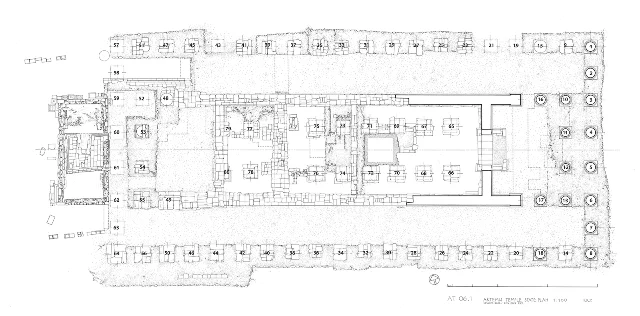
The preserved building is categorically a pseudodipteros with spacious amphiprostyle porches, but Yegül’s construction analysis separates the work into two major phases. The Hellenistic phase is visible in the cella walls, interior column foundations, bar clamps, square dowels without pouring channels, and the absence of lewis holes. The Roman phase is visible in the exterior peristyle, east crosswall, west wall, butterfly clamps, channeled dowels, standard lewis holes, and mortared rubble encasing the marble foundations. 6
Rome also changed the sacred logic of the building. The Roman phase divided the cella into two equal-length, back-to-back chambers, allowing Artemis and the imperial cult to occupy the same monumental shell. 6 The Cambridge University Press blog describes the same second-century CE redesign under Hadrian as a conversion into twin chambers, one for Artemis and one for the imperial cult, with a comparison to the Temple of Venus and Roma in Rome. 7
The imperial presence was not abstract. Colossal Antonine portraits found in and around the temple, tentatively associated with Antoninus Pius, Marcus Aurelius, Faustina the Elder, Lucilla, and Commodus, were reconstructed as 6-8 meters tall and belonged to the temple after the Roman reconfiguration. 8
One can almost hear the Roman solution: keep the old goddess, add the emperor, make the unfinished thing useful.
The temple that refused to end
The final irony is that the Temple of Artemis at Sardis was still not truly finished when pagan use ceased in the fourth century AD. Yegül writes that, except for the southwest corner column, none of the west peristyle columns had even been started at foundation level, and that even at the end of its life as a pagan temple the building remained largely unfinished. 6 Afterward, a small church was built at the southeast corner, marble was quarried for reuse and lime, and landslides from the acropolis buried much of the ruin by the ninth or tenth century. 8
This is why Sardis is not best understood as a sequence of clean replacements: Lydian, then Persian, then Greek, then Roman, then Christian. The real city behaved like its own temple. A Hellenistic cella survived inside a Roman casing. A Lydian sanctuary survived inside a Greek goddess’s name. A Croeseid memory lay near later coins. A queen’s dedication survived as a copy. An imperial cult entered the same stone body as Artemis. A church appeared at the corner of the abandoned pagan house.
The Sacred Blend, in this chapter, is not bloodline alone. It is architecture.
Sardis learned Greek, yes. It built a theater, a gymnasium, a polis identity, and a Seleucid capital’s archive. But it did so on old sacred ground, beside the road and river that had made Lydia powerful long before Alexander arrived. The Temple of Artemis never reached the pure completeness its builders imagined. That is why it tells the truth. Sardis was never pure. Sardis endured because it knew how to remain unfinished.
Add more perspectives or context around this Post.